
Author: Swift Water Restore Editorial Team

  • Storm Damage Repair in Corpus Christi: First Steps

    Storm Damage Repair in Corpus Christi: First Steps

    Storm damage repair in Corpus Christi follows rules that inland Texas does not have. Nueces County is one of the 14 first-tier coastal counties where wind and hail coverage often comes from the Texas Windstorm Insurance Association (TWIA), roof replacements and major repairs need a Texas Department of Insurance windstorm inspection, and flood water is a separate policy with a 30-day waiting period. After a tropical storm, hurricane or a strong Gulf squall line, the order is the same: protect the house from more water, document, report the claim to the right insurer, and dry what got wet before mold sets in.

    Hurricane season on the Coastal Bend

    The National Weather Service office in Corpus Christi puts the season plainly in its 2026 South Texas Hurricane Guide: “The hurricane season starts June 1 and ends November 30. The peak threat for the Texas coast exists from August through September.” The same guide warns that flood insurance takes 30 days to go into effect, so waiting until a storm is named is too late. Strong thunderstorms with wind and hail also hit the area outside hurricane season, and the steps below apply to them too.

    Who covers what: homeowners, TWIA and flood

    DamageWhere the claim usually goesKey rule
    Wind or hail opens the roof, rain gets inTWIA policy, if you have one, or your homeowners policy if it includes windTWIA: report within one year (365 days) of the damage
    Rising water, storm surge, water entering at ground levelFlood policy (NFIP or private)FEMA: most homeowners insurance does not cover flood; typically a 30-day wait for a new NFIP policy
    Burst pipe, appliance leak, other sudden waterHomeowners policyDepends on policy wording

    According to the TWIA FAQ, its designated area includes all 14 first-tier coastal counties, Nueces among them, plus parts of Harris County east of Highway 146; a TWIA policy covers wind and hail damage only; and the deadline to report a claim is one year (365 days) from the date the damage occurred, with a possible 180-day extension for good cause. Claims can be reported at (800) 788-8247 (TWIA, Claims Process). On flood, FEMA states that most homeowners insurance does not cover flood damage. Our page on water damage vs. flood damage explains why the source of the water decides which policy responds.

    The windstorm inspection: why it matters for repairs

    This is the rule most often missed after a coastal storm. TDI says properties in the 14 coastal counties and parts of Harris County are in its designated area, and that most new construction, roof replacements, major repairs and other alterations there require an inspection and a certificate of compliance. Roof repairs of less than 100 square feet that do not involve decking are exempt. A WPI-8 is issued for ongoing construction and a WPI-8-E for completed construction (TDI, What you need to know about windstorm inspections).

    TDI’s advice on making repairs after a storm is direct: don’t make your final payment until the contractor finishes all work and a Certificate of Compliance, Form WPI-8, is issued by TDI for the work performed. The Windstorm Inspections Program is at 800-248-6032, option 3. Ask any roofer, before signing, who requests the inspection and when.
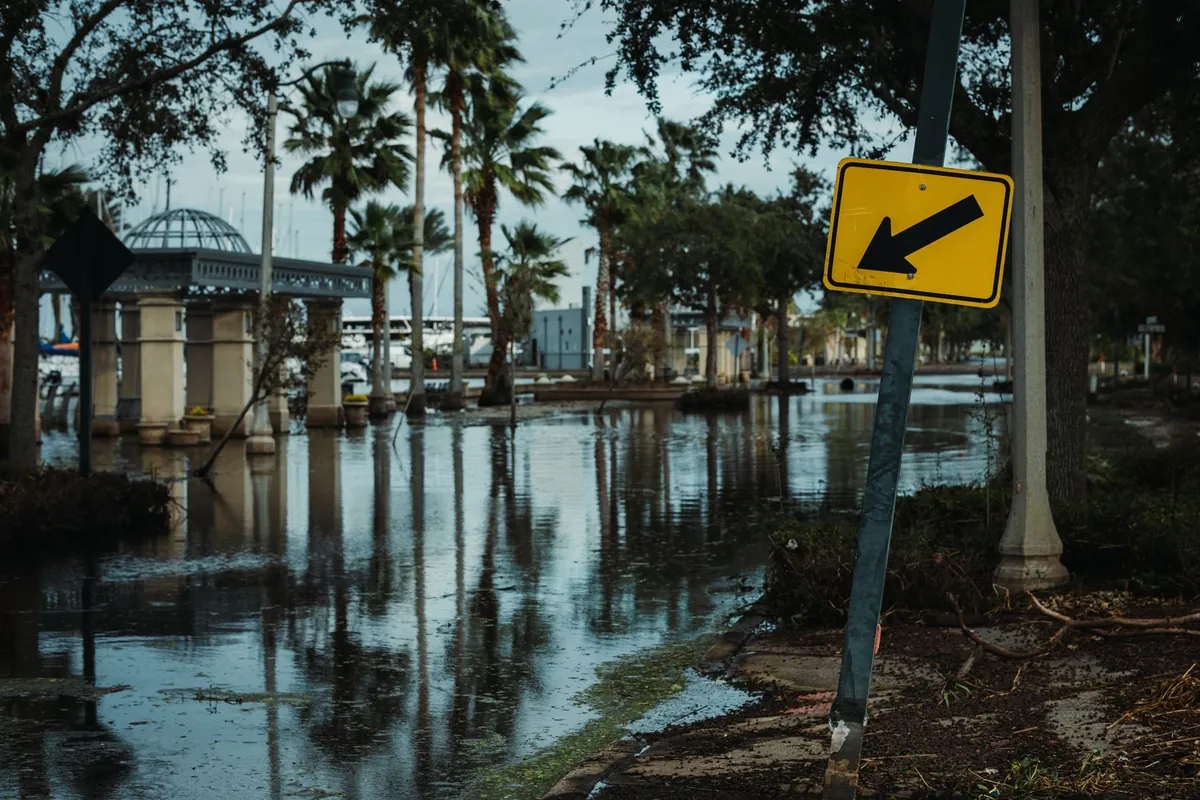
    Flooded street lined with palm trees and a leaning traffic sign after a storm
    Water that rises from the ground is a flood claim, separate from wind and hail coverage. Photo: Connor Scott McManus / Pexels

    The first days after the storm

    1. Stay safe. Keep out of standing water near outlets and appliances, and away from sagging wet ceilings.
    2. Photograph before cleanup. Roof and siding from the ground, broken windows, water lines on walls, every wet room and damaged item.
    3. Make temporary repairs. TDI says to do what you need to keep the damage from getting worse, like covering it with a tarp or making temporary repairs, and to keep receipts for all expenses (TDI). Its home insurance guide adds that permanent repairs before the company sees the damage can lead to a denied claim.
    4. Report the claim to TWIA, your homeowners insurer, your flood insurer, or all three if the damage has more than one cause.
    5. Start drying. The EPA says to dry water-damaged areas and items within 24-48 hours to prevent mold growth (EPA). In a humid coastal house that window is short.

    Once a claim is filed, TDI says the company has 15 business days to acknowledge it, and once it agrees to pay it must pay within five business days; TDI can extend deadlines by 15 days after a weather-related catastrophe. Contractors who show up uninvited deserve caution: TDI says it is against the law for out-of-town contractors to ask for a down payment before they start and for any contractor to offer to waive your deductible (TDI, How to avoid contracting scams).

    Wet drywall, insulation or flooring after a Gulf storm? Call (844) 434-2093 to check which participating water damage providers serve Corpus Christi, Portland, Robstown and nearby areas. A partner call service answers and we may be paid when you call; you decide whether to hire anyone.

    City contacts in Corpus Christi

    For city services, including reporting problems in the street or right-of-way, the City of Corpus Christi’s 3-1-1 Call Center takes calls at 3-1-1 from a mobile phone inside the city or 361-826-2489 from a landline or outside the city, Monday to Friday 8 a.m. to 5 p.m.; service requests can also be submitted through the online portal or the MyCC311 app at any time (City of Corpus Christi, 3-1-1 Call Center). For an immediate danger such as downed power lines or a gas smell, call 911.

    Our Corpus Christi water damage restoration page covers non-storm leaks, and ceiling and roof water damage in Texas explains what happens to a ceiling after a roof leak.

    Frequently asked questions

    Does TWIA cover flooding from a hurricane?

    No. TWIA says its policy covers wind and hail damage only. Flood damage needs a flood policy.

    How long do I have to report a TWIA claim?

    One year (365 days) from the date the damage occurred, according to TWIA, with a possible 180-day extension for good cause.

    Do roof repairs in Corpus Christi need a windstorm inspection?

    Roof replacements and major repairs in the designated catastrophe area generally do. TDI exempts roof repairs of less than 100 square feet that don’t involve decking.

    Can I buy flood insurance when a storm is coming?

    You can, but FEMA says there is typically a 30-day waiting period before a new NFIP policy takes effect, so it will not cover a storm that is days away.

    Should I pay the roofer in full when the work is done?

    TDI advises not making the final payment until the work is finished and the Certificate of Compliance (WPI-8) has been issued.

    Sources consulted November 13, 2026: NWS Corpus Christi, 2026 South Texas Hurricane Guide; TWIA, FAQs and Claims Process (twia.org); Texas Department of Insurance, windstorm inspections, making repairs after a storm, getting a claim paid, contracting scams and Home insurance guide; FEMA, Flood Insurance (updated October 20, 2026); City of Corpus Christi, 3-1-1 Call Center; U.S. EPA, A Brief Guide to Mold, Moisture and Your Home. General information, not legal or insurance advice.

    Checking what is available in your area

    swiftwaterrestore.com is a connection service. We do not perform restoration, roofing or plumbing work and we do not employ technicians. If storm water has reached the inside of a home in Corpus Christi or elsewhere on the Texas coast, call (844) 434-2093: a partner call service checks which participating providers serve your area. Availability varies by area, and you decide whether to move forward with anyone you speak to.

  • Storm Damage Restoration in Midland & Odessa, TX

    Storm Damage Restoration in Midland & Odessa, TX

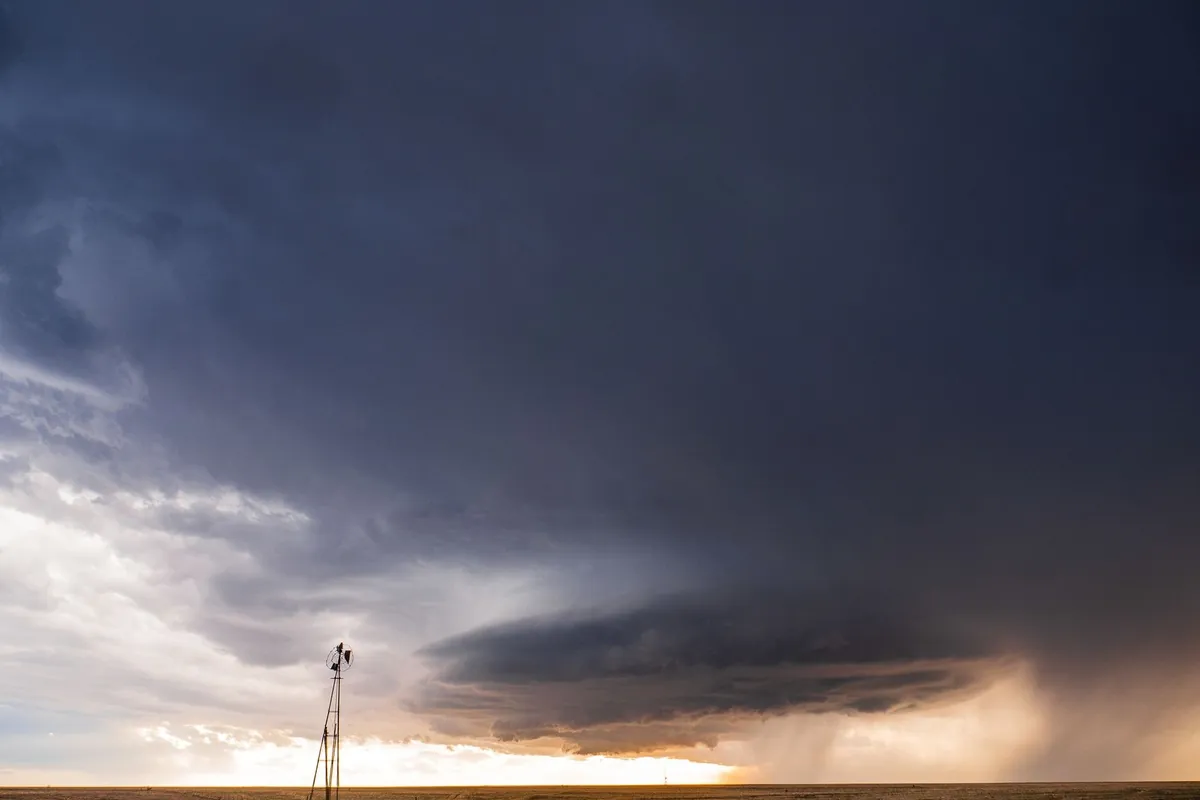
    In Midland and Odessa, storm damage usually arrives fast and from above: hail that breaks shingles, skylights and windows, wind that lifts roofing, and a short burst of very heavy rain that finds every opening. The National Weather Service office in Midland describes the pattern in its climate narrative: most of the area’s yearly rain falls in “very violent spring and early summer thunderstorms,” usually with excessive rainfall over limited areas “and sometimes hail.” After a storm, the job is to stop water getting in, document the damage, file the claim quickly and get anything wet inside the house dried before it turns into a mold problem.

    What storm damage restoration covers in the Permian Basin

    “Storm damage restoration” is a wide label. In practice it splits into the outside of the house, which is roofing, siding, windows and fencing, and the inside, which is everything the water reached. Restoration companies focus on the inside and on emergency protection:

    • Emergency protection: tarping a damaged roof section, boarding a broken window, covering an open skylight.
    • Water removal: extracting water from carpet and floors after rain came through the roof or under a door.
    • Tear-out and drying: removing soaked ceiling drywall and insulation, then drying the framing and attic with air movers and dehumidifiers.
    • Documentation: photos, moisture readings and a list of removed materials for the adjuster.

    The roof replacement itself is a roofing job. In Texas there is no statewide roofing-contractor license; a 2025 bill that would have created one, HB 3344, did not pass. That makes the local rules in Midland and Odessa, covered below, more important.

    The first 48 hours after hail or wind

    StepWhat to doWhat Texas sources say
    1. SafetyKeep out of rooms with sagging, wet ceilings; switch off power to wet areas from a dry spot–
    2. PhotosPhotograph the roof from the ground, broken windows, hail on the ground, every wet roomEvidence for the adjuster
    3. Temporary repairsTarp, board up, extract water; keep every receiptTDI: “Make temporary repairs to prevent more damage” and save receipts; your policy may pay for them
    4. ClaimFile as soon as you canTDI: file “as soon as you can”; some policies have a one-year deadline
    5. DryingGet wet drywall, insulation and flooring dried or removedEPA: dry within 24-48 hours to prevent mold growth

    One warning from the Texas Department of Insurance’s Home insurance guide: make only temporary repairs before the adjuster sees the damage, because the company might deny your claim if you make permanent repairs first. Tarping and drying protect the house; a new roof before inspection can cost you the claim.

    Filing the insurance claim in Texas

    TDI’s guidance after hail is short: file a claim as soon as you can if hail or strong winds damaged your home, your policy may pay for temporary repairs, and save all receipts (TDI, Hail damage to your home or car? What to do next). Once you file, Texas sets deadlines for the insurer. According to TDI’s steps to getting a claim paid, the company has 15 business days to acknowledge your claim, can extend its decision deadline by 45 days if it tells you why, TDI can add 15 more days after a weather-related catastrophe, and once the company agrees to pay it must pay within five business days.

    Before settling, TDI recommends getting multiple bids from contractors and comparing them with the adjuster’s report (TDI, Help after a storm). If you hire a public adjuster, TDI says they are licensed by TDI, can charge up to 10% of what the insurer pays on the claim, and cannot act as your contractor. Questions go to the TDI Help Line at 800-252-3439. Our guide to filing a water damage insurance claim in Texas covers the paperwork.

    Hailstones scattered on wet pavement after a storm
    Photograph hail on the ground and every wet room before cleanup starts. Photo: Julia Filirovska / Pexels

    Storm chasers and the deductible law

    Large hail events bring contractors from out of town. TDI’s advice on avoiding contracting scams is worth reading before anyone climbs your roof: it is against the law for out-of-town contractors to ask for a down payment before they start, it is against the law for a contractor to offer to waive an insurance deductible, and you should not sign a contract with blank spaces. Texas Insurance Code chapter 707, added in 2019 by HB 2102, requires the insured to pay any applicable deductible, and TDI says violators can face up to a $2,000 fine and up to six months in jail. Offers to waive a deductible can be reported to the Texas Attorney General at 800-621-0508.

    Midland and Odessa: permits and city contacts

    Midland. The city says a residential building permit is required for new construction, additions, remodeling and repairs, and that most construction projects also require a licensed and bonded contractor who is registered with the City of Midland; the Permitting Clerk is at 432-685-7390 (City of Midland, Building Permits). For a water line break or a wastewater stoppage on the city side, the Water & Wastewater Maintenance Division handles emergency repairs: 432-685-7270 during business hours, 432-685-7340 after hours (City of Midland).

    Odessa. Building Inspection, 411 W. 8th Street, issues renovation permits and handles contractor registration for building, remodeling, electrical, plumbing and mechanical work; the city’s main number is 432-335-3200 (City of Odessa, Permits/Licenses). Ask any roofer or restoration company whether they are registered with the city and who pulls the permit.

    For water damage help in each city, see our Midland water damage restoration and Odessa water damage restoration pages.

    Ceiling stained or carpet soaked after a hailstorm? Call (844) 434-2093 to check which participating restoration providers serve Midland, Odessa and nearby towns. A partner call service answers and we may be paid when you call; you decide whether to hire anyone.

    Flash flooding and flood insurance

    The NWS notes that because the countryside is flat, local flooding occurs but is usually short. Short does not mean harmless: water that comes in at ground level is treated differently by insurers. TDI’s guide says most home policies don’t cover damage caused by floods and most flood policies have a 30-day waiting period before they take effect. Our page on water damage vs. flood damage explains the difference, and storm and flood damage cleanup in Texas covers the cleanup.

    Frequently asked questions

    How soon should I file a hail claim in Texas?

    TDI says to file as soon as you can. Some policies have a one-year deadline, so check yours.

    Can I fix the roof before the adjuster comes?

    Make temporary repairs such as tarping, and keep receipts. TDI warns that permanent repairs before the company sees the damage can lead to a denied claim.

    Can a roofer pay my deductible?

    No. It is illegal in Texas for a contractor to offer to waive or pay your insurance deductible.

    Does Texas license roofers?

    There is no statewide roofing license; a 2025 bill to create one did not pass. Midland requires contractor registration for most projects, and Odessa registers building contractors.

    How fast does water from a roof leak need to be dried?

    The EPA says to dry water-damaged areas and items within 24-48 hours to prevent mold growth (EPA).

    Sources consulted November 13, 2026: NWS Midland, Climate Narrative (weather.gov/maf); Texas Department of Insurance pages on hail, storm recovery, claim payment, contracting scams and public adjusters, and the Home insurance guide (updated June 1, 2026); Texas Insurance Code ch. 707; Texas Legislature, HB 3344 (89R) history; City of Midland, Building Permits and Water & Wastewater Maintenance; City of Odessa, Permits/Licenses; U.S. EPA, A Brief Guide to Mold, Moisture and Your Home. General information, not legal or insurance advice.

    Checking what is available in your area

    swiftwaterrestore.com is a connection service. We do not perform restoration, roofing or plumbing work and we do not employ technicians. If storm water has reached the inside of a home in Midland, Odessa or elsewhere in Texas, call (844) 434-2093: a partner call service checks which participating providers serve your area. Availability varies by area, and you decide whether to move forward with anyone you speak to.
  • Water Heater Leaking From the Bottom: What to Do

    Water Heater Leaking From the Bottom: What to Do

    A water heater leaking from the bottom is either a fitting or valve dripping down the side of the tank, or the tank itself has started to fail. The first case can often be repaired; the second cannot, because a corroded tank only gets worse. Either way, the safe first moves are the same: shut off the cold water supply to the heater, turn off the gas or the breaker, keep away from the hot water, and get the water off the floor before it spreads into drywall, baseboards and flooring. Then find out where the water is really coming from.

    First 15 minutes: make it safe

    1. If you smell gas, leave. The Railroad Commission of Texas describes natural gas as smelling like rotten eggs and says: if you smell natural gas, leave the area immediately, and do not turn on lights or appliances or use your telephone (RRC, Gas Leaks Public Education). Call your gas company or 911 from outside.
    2. Turn off the energy. On a gas heater, set the gas control to off. On an electric heater, switch off its breaker from a dry spot. Do not touch the unit or wiring while standing in water.
    3. Close the cold water inlet valve on the pipe that feeds the top of the tank. If it will not close, shut the main water valve to the house.
    4. Watch the temperature. Water from the tank can scald. The CPSC notes that burns can occur with a six-second exposure to 140 degree water (CPSC, Avoiding Tap Water Scalds).
    5. Get the water up. Towels, a wet vacuum, and fans. Photograph the area first for your insurer.

    Where the water is coming from

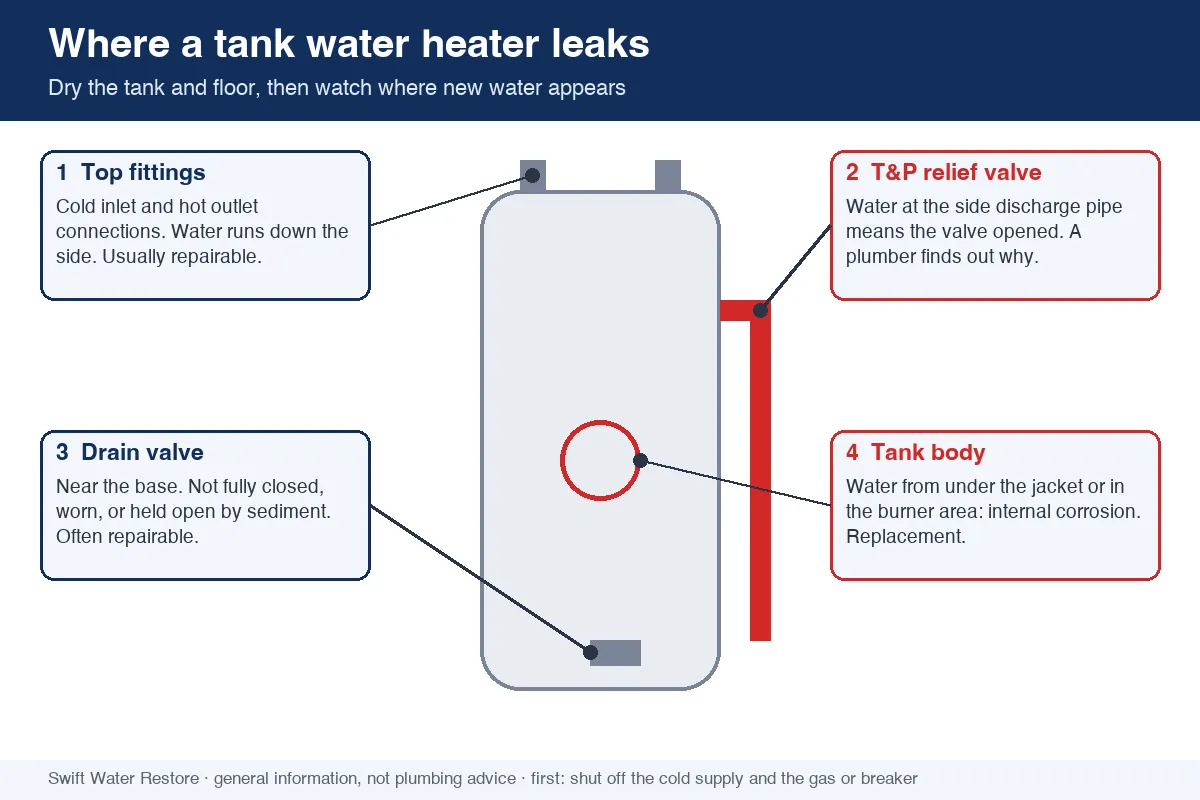
    Dry the outside of the tank and the floor, then watch where new water appears. Water that runs down the side and collects underneath can start well above the bottom.

    Where you see waterLikely sourceUsually
    Dripping from the drain valve near the baseValve not fully closed, worn washer, or sediment holding it openRepairable
    From the discharge pipe on the side of the tankTemperature-and-pressure relief valve openingNeeds a plumber to find out why
    Running down the side from the topInlet or outlet fittings, supply connectorsRepairable
    Water inside the burner compartment of a gas heater, or seeping from under the jacketInternal tank corrosionReplacement
    A few drops only when the heater starts from coldCondensation on a gas unitOften normal; have it checked if it continues

    Age is part of the answer. The U.S. Department of Energy’s Energy Saver Guide says most storage water heaters last 10-15 years. A leak from under the jacket of a tank in that range usually points to replacement rather than repair.

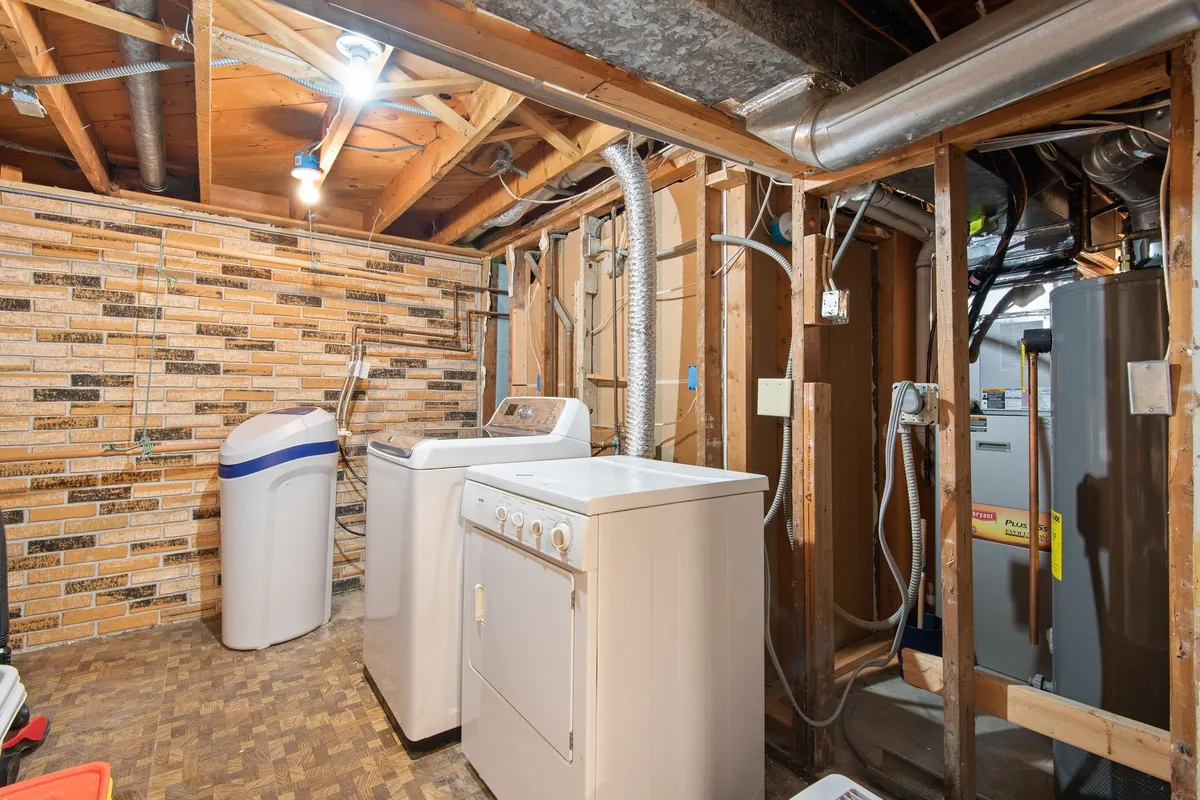
    Utility room with a washer, dryer, water softener and a tall tank water heater
    A tank water heater next to the laundry: water from a leak spreads under nearby appliances and into the walls. Photo: Đỗ Huy Hoàng / Pexels

    Gas and electric heaters: what changes

    The leak points are the same on both, but the safety steps and the clues differ.

    • Gas heaters have a burner under the tank and a flue running up through the middle. Water seen inside the burner compartment, or rust and scale around the burner, points to the tank itself. Turn the gas control to off before you look closely, and never relight a pilot on a heater that has been sitting in water; have a plumber check the controls first.
    • Electric heaters have heating elements behind access panels on the side of the tank. A leak at an element gasket shows up as water or rust streaks below a panel. Switch off the breaker before removing a panel, and leave the wiring to a professional if anything inside is wet.

    In Texas, many water heaters sit in a garage, a hall closet or an attic rather than a basement. A garage leak usually runs out under the door and is noticed early. A closet leak soaks the subfloor or slab edge and the bottom of the surrounding walls. An attic leak is the one to worry about most, because the first sign is often a stain on the ceiling of the room below, after the insulation and drywall have already absorbed a lot of water.

    What a plumber will check

    1. Whether the water comes from a fitting, a valve or the tank, after drying everything and watching it refill.
    2. The age of the heater, from the data plate or serial number.
    3. If the relief valve discharged: water pressure and the temperature setting, because the valve is a safety device that opens for a reason.
    4. The condition of the drain valve and whether sediment is keeping it from sealing.
    5. Whether a repair makes sense or whether the heater should be replaced, and whether a city permit is needed for the replacement.

    Ask for the cause in writing on the invoice. If you file an insurance claim for the water damage, the adjuster will want to know what failed.

    Who can repair or replace a water heater in Texas

    Water heater work is plumbing work. The Texas State Board of Plumbing Examiners is the state agency that licenses plumbers, and you can check a license on the state’s license lookup. Texas law has one homeowner exception: under Occupations Code section 1301.051, a property owner is not required to be licensed to perform plumbing in the property owner’s homestead. The same chapter requires cities with more than 5,000 inhabitants to regulate the installation and inspection of water heaters by ordinance, so a replacement may need a city permit even when you do it yourself. Our article on who can legally repair a burst pipe in Texas explains the homestead rule in more detail.

    When the new heater goes in, the CPSC recommends setting it to 120 degrees Fahrenheit, and DOE gives the same setting as safe for most of the population.

    The water damage is a separate job

    A plumber fixes the heater. The water that already soaked into the closet floor, the bottom of the drywall, a garage wall or the ceiling below an attic unit needs to be found and dried. The EPA says to dry water-damaged areas and items within 24-48 hours to prevent mold growth (EPA, A Brief Guide to Mold, Moisture and Your Home). Water from a heater in an attic can travel along framing and show up as a ceiling stain in another room, so moisture readings matter more than what you can see. See our guides to appliance water leak damage and ceiling water damage in Texas.

    Floor, wall or ceiling still wet after the leak? Call (844) 434-2093 to check which participating water damage providers serve your part of Texas. A partner call service answers and we may be paid when you call; you decide whether to hire anyone.

    Insurance: the heater and the damage are different

    Homeowners policies often treat the failed appliance and the damage it caused differently, and a tank that wore out with age is not the same as a sudden break. The answer is in your policy wording. Texas Department of Insurance guidance applies here as for any claim: photograph the damage, make only temporary repairs before the adjuster sees it, and keep receipts (TDI, Home insurance guide). Our page does insurance cover water damage in Texas? has more.

    Preventing the next leak

    • DOE suggests draining a quart of water from the tank every 3 months to remove sediment.
    • Know where the cold water shutoff is and make sure it turns.
    • Look at the tank, fittings and relief valve discharge pipe a few times a year for rust or drips.
    • Ask a plumber whether a drain pan is required where your heater sits, especially in an attic or over a finished floor.

    Frequently asked questions

    Can a water heater leaking from the bottom be fixed?

    If the water comes from the drain valve, a fitting or the relief valve, often yes. If the tank itself is leaking, it needs to be replaced.

    Is it safe to use hot water if the heater is leaking?

    Turn the heater off and close the cold supply until a plumber has looked at it. A leaking tank can fail further, and the water inside is hot enough to scald.

    Why is water coming out of the pipe on the side of my water heater?

    That pipe is the discharge from the temperature-and-pressure relief valve. Water there means the valve opened or is failing; have a licensed plumber find the cause.

    How long do water heaters last?

    DOE says most storage water heaters last 10-15 years; tankless heaters can last more than 20.

    Can I replace my own water heater in Texas?

    Texas law exempts a property owner doing plumbing in their own homestead from licensing, but cities over 5,000 inhabitants regulate water heater installation, so check the local permit rules first.

    Sources consulted November 13, 2026: Railroad Commission of Texas, Gas Leaks Public Education; U.S. CPSC, Avoiding Tap Water Scalds (publication 5098); U.S. DOE, Energy Saver Guide (2022); Texas State Board of Plumbing Examiners; Texas Occupations Code ch. 1301; Texas Department of Insurance, Home insurance guide; U.S. EPA, A Brief Guide to Mold, Moisture and Your Home. General information, not plumbing, legal or insurance advice.

    Checking what is available in your area

    swiftwaterrestore.com is a connection service. We do not perform restoration or plumbing work and we do not employ technicians. If you are dealing with interior water damage from a water heater leak in a Texas home, call (844) 434-2093: a partner call service checks which participating providers serve your area. Availability varies by area, and you decide whether to move forward with anyone you speak to.
  • Burst Pipe in Texas: Who Can Legally Repair It?

    When a pipe bursts, two different jobs start at the same moment. One is the plumbing repair: the split pipe, the failed fitting, the line that froze. The other is the water damage: wet drywall, soaked flooring, and moisture working its way into places you cannot see. In Texas, those two jobs are governed by different rules, and the people who show up to dry your house are not automatically the people allowed to fix the pipe.

    Knowing who is allowed to do what saves a lot of confusion on the day it happens.

    First, the water

    Shut off the water at the main valve to the house, and if water has reached outlets, fixtures or the electrical panel, stay out of standing water until the power to that area is off. Then document before anything is moved. Our guide to the first 60 minutes after water damage covers the sequence in more detail.

    The drying clock starts as soon as the leak does. The U.S. Environmental Protection Agency says that drying water-damaged areas and items within 24 to 48 hours is important to prevent mold growth (EPA, A Brief Guide to Mold, Moisture and Your Home). That is why the drying job usually cannot wait for the plumbing job to be finished.

    Who can repair the pipe in Texas

    Plumbing in Texas is licensed under Chapter 1301 of the Occupations Code, the Plumbing License Law, administered by the Texas State Board of Plumbing Examiners. The law’s definition of plumbing includes the installation, repair, service or maintenance of piping used to supply or distribute water, and of drain and waste piping (Texas State Board of Plumbing Examiners, The Plumbing License Law).

    Section 1301.351 sets the general rule: a person, other than a responsible master plumber, may not engage in plumbing unless the person holds the proper license, registration or endorsement and the work is supervised and controlled by a person licensed under the chapter. A person who advertises or offers to perform plumbing must secure the services of a responsible master plumber.

    There are exemptions, and two of them matter most to homeowners.

    Your own homestead

    Section 1301.051 is one sentence long: a property owner is not required to be licensed under the chapter to perform plumbing in the property owner’s homestead. If the burst pipe is in the house you own and live in, you may repair it yourself.

    The exemption is tied to your homestead. A rental house you own, a second home or a property you are fixing up to sell is not your homestead, so the exemption does not extend to it.

    Maintenance staff

    Section 1301.053 exempts a person regularly employed as a maintenance person who does not engage in plumbing for the public. That is the exemption that covers, for example, an apartment property’s own maintenance employee working on that property. It does not cover a handyman who offers repairs to the public.

    The same section notes that exempt work is still subject to inspection and approval under applicable state law or municipal ordinance. Whether your repair needs a permit or an inspection is a question for your city.

    What the restoration company does, and does not do

    A water damage restoration crew extracts water, removes materials that cannot be dried, sets up drying equipment and monitors moisture until the structure is dry. Some restoration companies also have licensed plumbers on staff or work with plumbing companies they call in. Others do not touch the pipe at all.

    Ask directly, on the first call:

    • Will someone repair the pipe, or do I need to call a plumber separately?
    • If your company is doing the repair, who is the licensed plumber, and what is the license number?
    • Can you start drying before the pipe is repaired, with the water to that line shut off?
    • Will you document the failed pipe or fitting before it is removed?

    That last point is easy to lose in the moment. The broken piece is the clearest evidence of what failed, and it is worth photographing and keeping.

    Where burst pipes do their damage

    A pipe that fails inside a wall or ceiling rarely puts water only where it broke. Water runs along framing and spreads under flooring before it shows. Our page on burst pipe water damage explains how restoration crews trace that path, and our page on ceiling water damage covers leaks that start above you. A tank that fails in a closet or garage spreads water the same way; see how to handle a water heater leak at the base.

    Questions homeowners ask

    Can I fix a burst pipe myself in Texas?

    In your own homestead, yes. Section 1301.051 of the Texas Occupations Code says a property owner is not required to be licensed to perform plumbing in the property owner’s homestead. The exemption does not cover property you own but do not live in.

    Can a handyman repair a burst pipe in Texas?

    Under section 1301.351, a person may not engage in plumbing unless properly licensed and supervised by a licensed plumber, unless an exemption applies. A handyman offering plumbing repairs to the public does not fall under the homestead or maintenance-employee exemptions.

    Does the water damage company fix the pipe?

    Sometimes. Some restoration companies have licensed plumbers on staff or bring one in, and others handle only the drying and repairs to the building. Ask on the first call, and ask for the plumber’s license number if they do the repair.

    Should I wait for the plumber before drying starts?

    Not if the water to the broken line is off. EPA advises drying water-damaged areas within 24 to 48 hours to prevent mold growth, so the drying generally needs to begin promptly.

    Homeowners on the Gulf Coast can also start from our page on water damage restoration in Corpus Christi.

    Checking what is available in your area

    swiftwaterrestore.com is a connection service. We do not perform restoration or plumbing work and we do not employ technicians. If you are dealing with interior water damage in a Texas home, call (844) 434-2093: a partner call service checks which participating providers serve your area. Availability varies by area, and you decide whether to move forward with anyone you speak to.

  • Texas Mold Rules: When TDLR Licensing and the Certificate Apply

    Texas regulates mold work more closely than most homeowners expect. There are separate licenses for the people who assess mold and the people who remove it, a written protocol that the removal crew has to follow, and a certificate at the end that you are expected to keep for years. There is also a size threshold, 25 contiguous square feet, that gets quoted often and understood less often.

    Here is how the system works, drawn from the Texas Department of Licensing and Regulation (TDLR), which oversees it.

    Who regulates mold work in Texas

    TDLR regulates mold assessment and remediation businesses under Chapter 1958 of the Texas Occupations Code and the Texas Mold Assessment and Remediation Rules, 16 Texas Administrative Code Chapter 78. According to TDLR’s Consumer Mold Information Sheet, all companies and individuals who perform mold-related activities in Texas must be licensed by TDLR unless exempt (TDLR, Consumer Mold Information Sheet).

    Licensed assessors and remediators are required to give a copy of that information sheet to each client, and to the property owner if different, before starting any mold-related activity. If a company is about to start work and you have not received it, that is worth a question.

    Two things the rules do not do are also worth knowing. They do not require any property owner or occupant to clean up mold or have it cleaned up. And TDLR states there are no national or state standards for a “safe” level of mold.

    Two roles, kept apart

    The Texas system is built on a split between assessment and remediation.

    Mold assessment

    A mold assessment consultant or technician inspects the building to evaluate whether mold growth is present and to what extent. TDLR notes that samples may be taken, but that sampling is not necessary in many cases. When cleanup is needed, a licensed mold assessment consultant prepares a mold remediation protocol. The protocol must specify the estimated quantities and locations of materials to be remediated, the methods to be used, and the clearance criteria that must be met.

    Mold remediation

    A licensed mold remediation contractor follows that protocol and its own written work plan.

    To prevent conflicts of interest, TDLR’s rules prohibit a licensee from conducting both mold assessment and mold remediation on the same project. A company may hold both kinds of license, but not use both on your job.

    What the 25 square foot rule actually says

    The number comes up in almost every conversation about Texas mold, usually in the form “under 25 square feet, anyone can do it.” TDLR’s own wording is more careful.

    • TDLR’s FAQ says that in most instances, areas of visible mold of less than 25 contiguous square feet can be cleaned up by people who are not licensed (TDLR, Mold Assessors and Remediators FAQ).
    • Homeowners have their own exemption. TDLR says a homeowner can take samples or clean up mold in the home without a license, and that an owner, managing agent or employee of an owner of residential property does not need a license unless the property has 10 or more residential dwelling units.
    • The size exemption applies to people who are not licensed. TDLR’s FAQ states that a licensed mold remediation contractor hired for a project under 25 contiguous square feet is not exempt from the law and rules. It must still develop a work plan that follows a protocol written by a licensed mold assessment consultant. It does not, however, have to submit a project notification to TDLR for that size of job.

    The practical point: if you hire a licensed company, you are hiring into the full process regardless of the size of the area. If you hire an unlicensed handyman for a small area, the size threshold is what makes that legal, and the protections of the licensed process do not come with it.

    Clearance and the certificate

    Before a remediation project counts as successful, a mold assessment consultant must conduct a post-remediation assessment. TDLR describes it as an inspection to confirm that the work area has no visible mold or wood rot remaining, that the project followed the protocol and work plan, and that it meets the clearance criteria in the protocol. The consultant must give you a passed clearance report. If the project fails clearance, further remediation is required.

    Then comes the Certificate of Mold Damage Remediation. According to TDLR, no later than the 10th day after the project stop date, the remediation contractor must sign and give you the certificate, and the consultant who conducted the post-remediation assessment must also sign it. The consultant must state on the certificate whether the underlying cause of the mold has been corrected.

    Keep it. TDLR notes that if you sell the property, the law requires you to give the buyer a copy of all such certificates you received for that property within the preceding five years.

    TDLR’s FAQ adds a caution for homeowners who do their own remediation: a consultant who did not prepare a protocol before the work cannot declare that the project has achieved clearance. If you think you will want a certificate, plan for it before the work starts, not after.

    Checking a license

    TDLR says a licensed individual is required to carry a current TDLR license certificate with the license number on it. You can confirm it, and look up companies, with the TDLR license search. Complaints about a licensee or about unlicensed activity go to TDLR, and its FAQ says complaints must be filed within two years of the event.

    Questions homeowners ask

    Do I need a licensed mold remediator in Texas?

    Companies and individuals doing mold work for others must be licensed by TDLR unless an exemption applies. A homeowner can clean up mold in their own home without a license, and TDLR says that in most instances areas of visible mold under 25 contiguous square feet can be cleaned up by people who are not licensed.

    What is a Certificate of Mold Damage Remediation?

    It is a document the remediation contractor must sign and give you no later than the 10th day after the project ends, also signed by the consultant who did the post-remediation assessment. It states whether the underlying cause of the mold was corrected, and you must give copies to a buyer if you sell within five years.

    Can the company that tested my home also do the removal?

    Not on the same project. TDLR’s rules prohibit a licensee from conducting both mold assessment and mold remediation on the same project.

    Does mold testing always involve lab samples?

    No. TDLR notes that samples may be taken, but sampling is not necessary in many cases.

    Mold usually follows water, and the speed at which it does is covered in our article on what happens to materials after a leak sits. Our mold remediation page describes how mold requests are handled, and our list of questions to ask a restoration company pairs well with the license check above.

    Checking what is available in your area

    swiftwaterrestore.com is a connection service. We do not perform restoration or mold remediation and we do not employ technicians. Mold calls go to a separate line, (866) 228-7583, where a partner call service checks whether a participating mold remediation company serves your area. Availability varies by area, and you decide whether to move forward with anyone you speak to.

Disclaimer: Swift Water Restore is a service to assist homeowners in connecting with local service providers. All contractors/providers are independent and Swift Water Restore does not warrant or guarantee any work performed. It is the responsibility of the homeowner to verify that the hired contractor furnishes the necessary license and insurance required for the work being performed. All persons depicted in a photo or video are actors or models and not contractors listed on Swift Water Restore.

Same-day and 24/7 emergency services are subject to provider participation, location, technician availability, and demand. Availability is not guaranteed and may vary by market and appointment capacity.