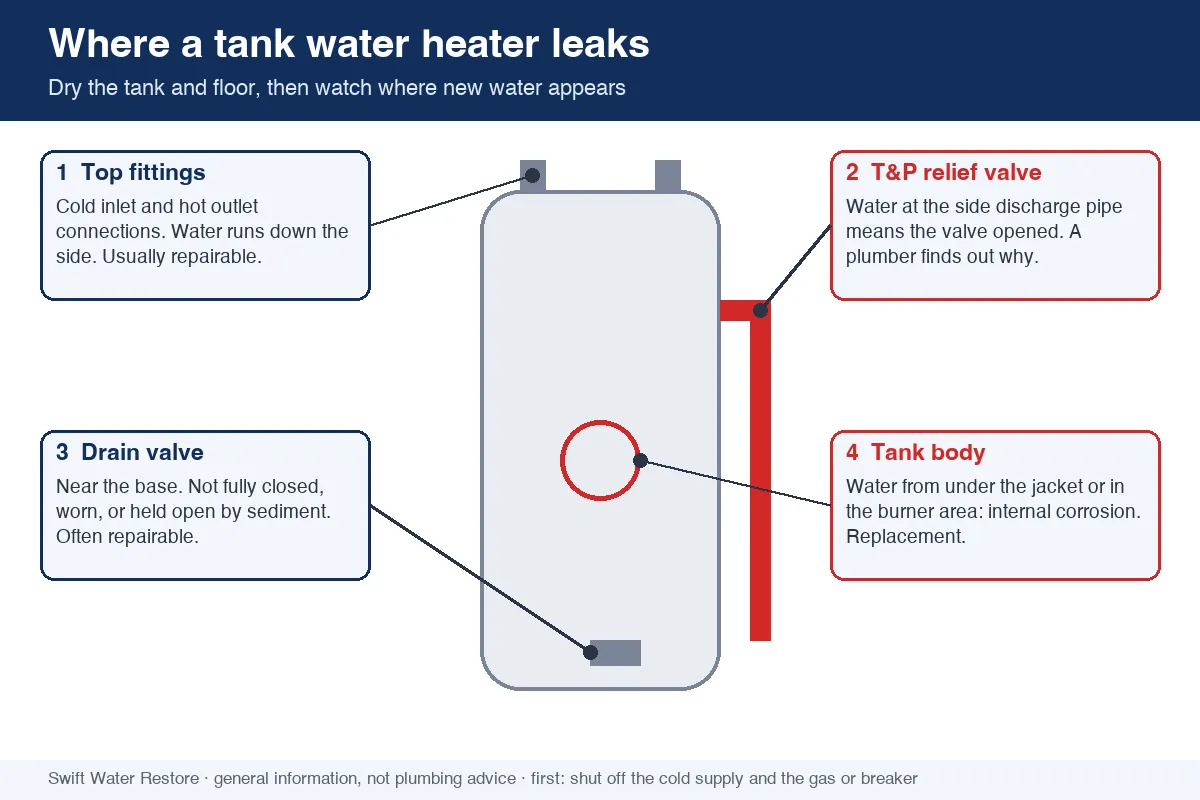
A water heater leaking from the bottom is either a fitting or valve dripping down the side of the tank, or the tank itself has started to fail. The first case can often be repaired; the second cannot, because a corroded tank only gets worse. Either way, the safe first moves are the same: shut off the cold water supply to the heater, turn off the gas or the breaker, keep away from the hot water, and get the water off the floor before it spreads into drywall, baseboards and flooring. Then find out where the water is really coming from.
Water spreading across the floor?
Shut off the water heater supply and the power or gas if it is safe, then call (844) 434-2093. A partner call service checks which participating restoration companies serve your area of Texas.
Call (844) 434-2093First 15 minutes: make it safe
- If you smell gas, leave. The Railroad Commission of Texas describes natural gas as smelling like rotten eggs and says: if you smell natural gas, leave the area immediately, and do not turn on lights or appliances or use your telephone (RRC, Gas Leaks Public Education). Call your gas company or 911 from outside.
- Turn off the energy. On a gas heater, set the gas control to off. On an electric heater, switch off its breaker from a dry spot. Do not touch the unit or wiring while standing in water.
- Close the cold water inlet valve on the pipe that feeds the top of the tank. If it will not close, shut the main water valve to the house.
- Watch the temperature. Water from the tank can scald. The CPSC notes that burns can occur with a six-second exposure to 140 degree water (CPSC, Avoiding Tap Water Scalds).
- Get the water up. Towels, a wet vacuum, and fans. Photograph the area first for your insurer.
Where the water is coming from
Dry the outside of the tank and the floor, then watch where new water appears. Water that runs down the side and collects underneath can start well above the bottom.
| Where you see water | Likely source | Usually |
|---|---|---|
| Dripping from the drain valve near the base | Valve not fully closed, worn washer, or sediment holding it open | Repairable |
| From the discharge pipe on the side of the tank | Temperature-and-pressure relief valve opening | Needs a plumber to find out why |
| Running down the side from the top | Inlet or outlet fittings, supply connectors | Repairable |
| Water inside the burner compartment of a gas heater, or seeping from under the jacket | Internal tank corrosion | Replacement |
| A few drops only when the heater starts from cold | Condensation on a gas unit | Often normal; have it checked if it continues |
Age is part of the answer. The U.S. Department of Energy’s Energy Saver Guide says most storage water heaters last 10-15 years. A leak from under the jacket of a tank in that range usually points to replacement rather than repair.
Gas and electric heaters: what changes
The leak points are the same on both, but the safety steps and the clues differ.
- Gas heaters have a burner under the tank and a flue running up through the middle. Water seen inside the burner compartment, or rust and scale around the burner, points to the tank itself. Turn the gas control to off before you look closely, and never relight a pilot on a heater that has been sitting in water; have a plumber check the controls first.
- Electric heaters have heating elements behind access panels on the side of the tank. A leak at an element gasket shows up as water or rust streaks below a panel. Switch off the breaker before removing a panel, and leave the wiring to a professional if anything inside is wet.
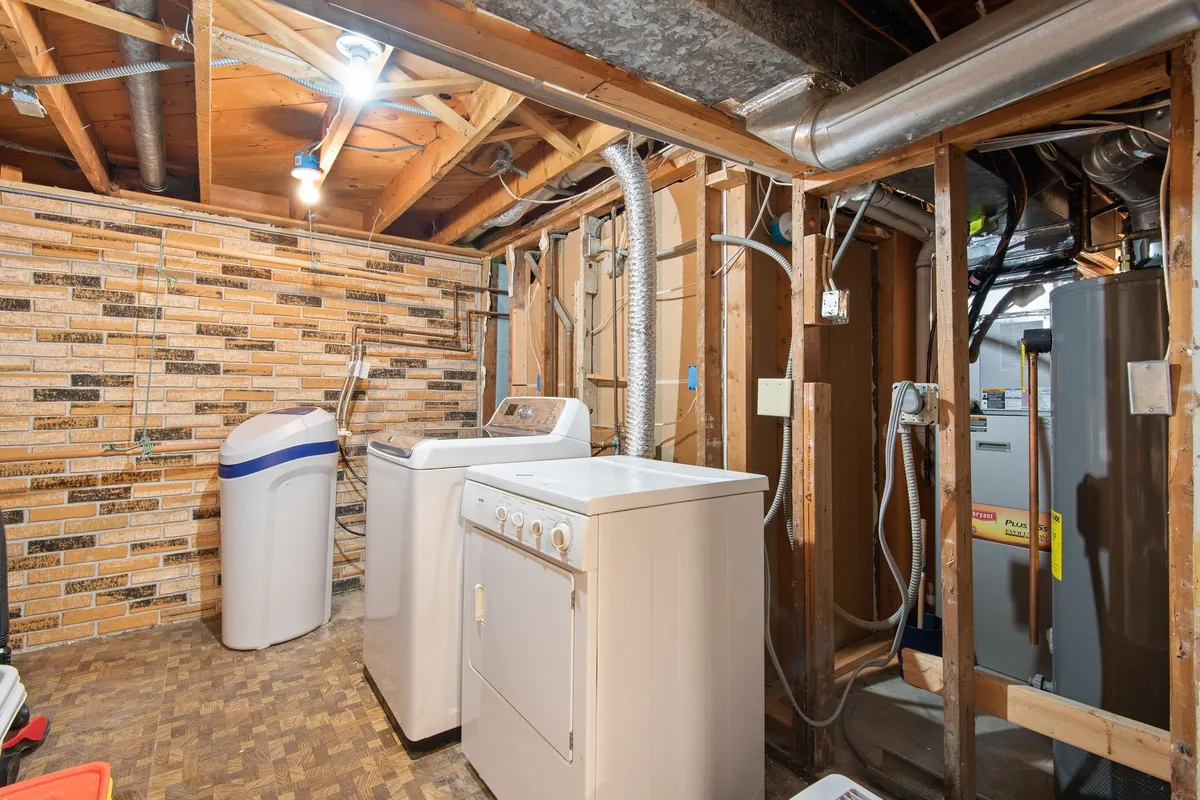
In Texas, many water heaters sit in a garage, a hall closet or an attic rather than a basement. A garage leak usually runs out under the door and is noticed early. A closet leak soaks the subfloor or slab edge and the bottom of the surrounding walls. An attic leak is the one to worry about most, because the first sign is often a stain on the ceiling of the room below, after the insulation and drywall have already absorbed a lot of water.
What a plumber will check
- Whether the water comes from a fitting, a valve or the tank, after drying everything and watching it refill.
- The age of the heater, from the data plate or serial number.
- If the relief valve discharged: water pressure and the temperature setting, because the valve is a safety device that opens for a reason.
- The condition of the drain valve and whether sediment is keeping it from sealing.
- Whether a repair makes sense or whether the heater should be replaced, and whether a city permit is needed for the replacement.
Ask for the cause in writing on the invoice. If you file an insurance claim for the water damage, the adjuster will want to know what failed.
Who can repair or replace a water heater in Texas
Water heater work is plumbing work. The Texas State Board of Plumbing Examiners is the state agency that licenses plumbers, and you can check a license on the state’s license lookup. Texas law has one homeowner exception: under Occupations Code section 1301.051, a property owner is not required to be licensed to perform plumbing in the property owner’s homestead. The same chapter requires cities with more than 5,000 inhabitants to regulate the installation and inspection of water heaters by ordinance, so a replacement may need a city permit even when you do it yourself. Our article on who can legally repair a burst pipe in Texas explains the homestead rule in more detail.
When the new heater goes in, the CPSC recommends setting it to 120 degrees Fahrenheit, and DOE gives the same setting as safe for most of the population.
The water damage is a separate job
A plumber fixes the heater. The water that already soaked into the closet floor, the bottom of the drywall, a garage wall or the ceiling below an attic unit needs to be found and dried. The EPA says to dry water-damaged areas and items within 24-48 hours to prevent mold growth (EPA, A Brief Guide to Mold, Moisture and Your Home). Water from a heater in an attic can travel along framing and show up as a ceiling stain in another room, so moisture readings matter more than what you can see. See our guides to appliance water leak damage and ceiling water damage in Texas.
Floor, wall or ceiling still wet after the leak? Call (844) 434-2093 to check which participating water damage providers serve your part of Texas. A partner call service answers and we may be paid when you call; you decide whether to hire anyone.
Insurance: the heater and the damage are different
Homeowners policies often treat the failed appliance and the damage it caused differently, and a tank that wore out with age is not the same as a sudden break. The answer is in your policy wording. Texas Department of Insurance guidance applies here as for any claim: photograph the damage, make only temporary repairs before the adjuster sees it, and keep receipts (TDI, Home insurance guide). Our page does insurance cover water damage in Texas? has more.
Preventing the next leak
- DOE suggests draining a quart of water from the tank every 3 months to remove sediment.
- Know where the cold water shutoff is and make sure it turns.
- Look at the tank, fittings and relief valve discharge pipe a few times a year for rust or drips.
- Ask a plumber whether a drain pan is required where your heater sits, especially in an attic or over a finished floor.
Frequently asked questions
Can a water heater leaking from the bottom be fixed?
If the water comes from the drain valve, a fitting or the relief valve, often yes. If the tank itself is leaking, it needs to be replaced.
Is it safe to use hot water if the heater is leaking?
Turn the heater off and close the cold supply until a plumber has looked at it. A leaking tank can fail further, and the water inside is hot enough to scald.
Why is water coming out of the pipe on the side of my water heater?
That pipe is the discharge from the temperature-and-pressure relief valve. Water there means the valve opened or is failing; have a licensed plumber find the cause.
How long do water heaters last?
DOE says most storage water heaters last 10-15 years; tankless heaters can last more than 20.
Can I replace my own water heater in Texas?
Texas law exempts a property owner doing plumbing in their own homestead from licensing, but cities over 5,000 inhabitants regulate water heater installation, so check the local permit rules first.
Sources consulted November 13, 2026: Railroad Commission of Texas, Gas Leaks Public Education; U.S. CPSC, Avoiding Tap Water Scalds (publication 5098); U.S. DOE, Energy Saver Guide (2022); Texas State Board of Plumbing Examiners; Texas Occupations Code ch. 1301; Texas Department of Insurance, Home insurance guide; U.S. EPA, A Brief Guide to Mold, Moisture and Your Home. General information, not plumbing, legal or insurance advice.
Checking what is available in your area
swiftwaterrestore.com is a connection service. We do not perform restoration or plumbing work and we do not employ technicians. If you are dealing with interior water damage from a water heater leak in a Texas home, call (844) 434-2093: a partner call service checks which participating providers serve your area. Availability varies by area, and you decide whether to move forward with anyone you speak to.
Water damage in Texas?
Call (844) 434-2093Calls to (844) 434-2093 are answered by a partner call service that checks whether a participating independent restoration company serves your area. We may be paid when you call. Swift Water Restore does not perform restoration work.